
Development Finance Private Debt Asset Class
What are MDBs and DFIs?
MDBs (Multilateral Development Banks) are generally known as international financial institutions chartered by two or more countries for the purpose of encouraging economic development in emerging markets and developing economies (EMDEs). They provide loans and grants to member nations to fund projects that support social and economic development, as well as climate resilience and adaptation.
DFIs (Development Finance Institutions) are generally known as national institutions that provide risk capital for economic development projects in EMDEs. DFIs prioritise development goals and provide loans and grants to finance projects that would otherwise not access financing from commercial lenders.
Both MDBs and DFIs finance sovereign and private sector borrowers. While some institutions provide concessional finance and grants in lower-income or higher-risk markets, a significant share of their activities consists of loans or equity investments and other financial products offered on commercial terms. A core principle underpinning MDB and DFI operations is additionality: they seek to provide financing, expertise or risk-sharing that is not sufficiently available from capital markets alone, thereby supporting projects and investments that might otherwise not proceed. Their role is to complement and mobilise private capital rather than compete with it.
What is the Development Finance Private Debt Asset Class?
The Development Finance Private Debt (DFPD) asset class is an emerging‑market private credit asset class comprised of assets originated by MDBs and DFIs to real‑economy companies and projects, offering institutional investors market-equivalent risk‑adjusted returns, diversification, and measurable development and climate impact.
Growing Asset class
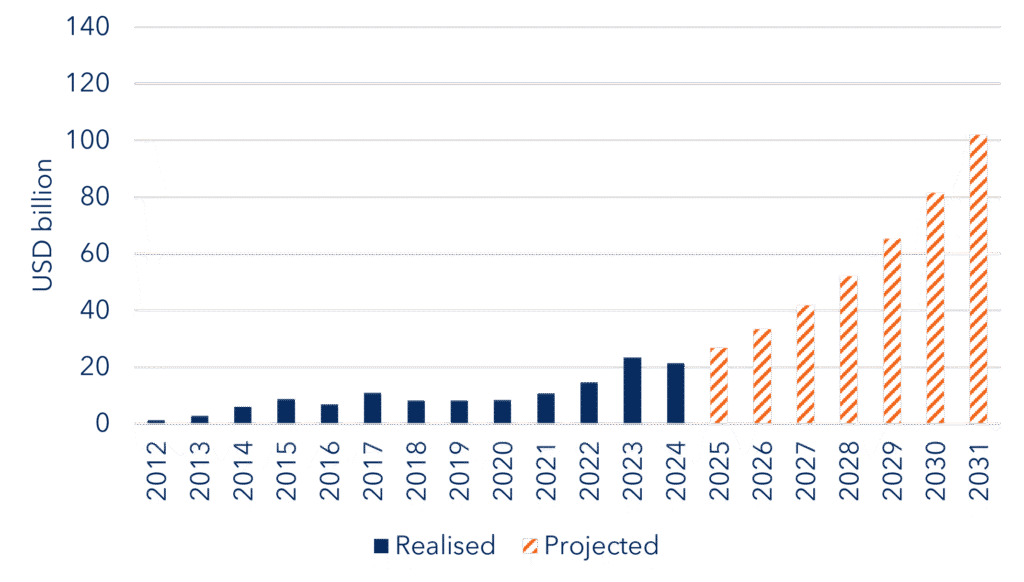
The asset class is growing as emerging markets face a persistent financing gap for climate and development, and public development budgets have come under pressure. MDBs and DFIs need to play a central role in addressing this gap by originating long‑term loans and transitioning from an originate-to-hold model to an originate-to-share model, mobilising institutional capital alongside their own balance sheets. Institutional investors can seize this opportunity by investing in high-quality assets structured by these institutions.
Characteristics of DFPD
GEMs is a joint MDB-DFI database that pools 30-year credit risk data on their EMDE lending operations.
Data includes:
- 1,200 obligors
- PD, LGD per contract
- Over 30 years since 1994
- 28 global MDB/DFIs contribution
Risk
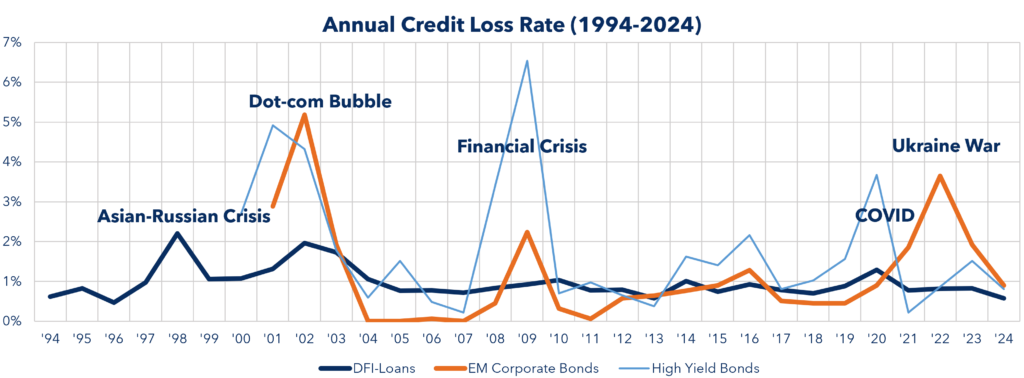
The asset class has become more visible and investable. The Global Emerging Markets Risk Database (GEMs), a joint credit database of MDBs and DFIs, now provides more than 30 years of loan‑level default and recovery data. This increased transparency allows investors to assess risk and allocate capital with greater confidence, accelerating the creation of the Development Finance Private Debt asset class.
Low credit losses, average default rates, and high recovery rates
From a credit perspective, the asset class is characterised by mostly senior, conservatively structured loans, strong documentation and reporting, and active monitoring by MDBs and DFIs. Long‑term GEMs data shows consistently low credit losses, with average default rates around 3–4% and high recovery rates of more than 70%, above those observed in comparable public credit markets. This has resulted in stable credit losses across market cycles, including periods of global stress.
Importantly, credit risk is assessed at the project or company level, rather than inferred from sovereign ratings. Historical data show that sovereign ceilings often overstate private‑sector risk in emerging markets. Well‑structured projects supported by MDBs and DFIs can achieve robust credit quality and resilience, even in lower‑rated countries.
Risk-adjusted returns
Returns in the asset class are driven by contractual cash flows and stable pricing. Credit spreads have historically shown lower volatility than comparable EM corporate bonds, sovereign bonds or high‑yield markets. As a result, DFPD has delivered market-equivalent risk-adjusted returns with lower volatility over the long term without the need for any blended or concessional capital.
Low correlation
DFPD show low correlation with public credit markets and other comparable assets. According to GEMs data, default rates in EMDEs show only moderate correlation with developed market high-yield benchmarks, 0.46 with S&P B-rated rms and 0.33 with Moody’s B3-rated.
Diversification of exposure vs liquid markets
DFPD provides exposure to countries and sectors that are often underrepresented in public debt markets, offering meaningful diversification benefits. This can improve overall portfolio efficiency for long-term investors seeking stable returns and resilience across market cycles. As an example, in ILX’s portfolio, the largest countries in standard emerging market debt indices, such as China or Brazil, are not widely represented in the ILX portfolio (<50%), while approximately 60% of ILX’s country exposures fall outside the top country allocations typically found in those benchmarks.
Additionally, sector allocations in DFPD also differ significantly from those of traditional emerging market debt benchmarks. Compared to the JP Morgan CEMBI BD Index, ILX’s portfolio has greater exposure to renewables, consumer sectors, industrials, and infrastructure, while having no exposure to oil & gas, telecommunications, or real estate. These differences reflect the development mandates of MDB and DFI assets, and provide investors with exposure to sectors that are typically underrepresented in public emerging market debt indices.

Financing the real economy
Alongside its financial characteristics, DFPD plays a direct role in financing the real economy in EMDEs. Capital is deployed into sectors critical for sustainable development and climate transition and adaptation, such as renewable energy, sustainable infrastructure, financial inclusion, food systems and essential services. These investments are subject to rigorous ESG standards applied by MDBs and DFIs and are closely aligned with the SDGs and climate objectives. Like this, impact is embedded in the asset class, without trade‑offs on returns. Financing irreplaceable services that support economic and social activity reinforces the asset class’s resilience while delivering tangible development outcomes.
How does it fit into the strategic asset allocation?
Within institutional portfolios, development finance private debt is typically considered across multiple allocation buckets. It shares characteristics with emerging market debt through its exposure to EMDEs, while also fitting within alternative credit. For investors with dedicated sustainability objectives, it may additionally form part of an impact allocation given its measurable development outcomes.
With a growing pipeline, improving data transparency and a proven long‑term track record, Development Finance Private Debt is emerging as a scalable, institutional‑grade private credit allocation, offering stable risk‑adjusted returns, diversification and meaningful contribution to development and climate goals.