Sustainability

0
MW
of installed renewable energy capacity, enough to power a city the size of Leiden
0
tCO₂e
emissions avoided, equivalent to the annual carbon footprint of around 2000 people

What is Impact Investing in Emerging Markets

Investing with Impact in Emerging Markets: investments made with the intention to generate positive, measurable social and environmental impact alongside a financial return, in economies where development needs and financing gaps are most significant. (Based on the GIIN definition of impact investing)

Sustainability Themes

Energy Access & Clean Energy

Wind turbines in a rural landscape representing renewable energy investment

Energy Access & Clean Energy

Energy projects that contribute to providing access to electricity, renewable energy and the efficient use of energy sources
View investments

Financial Inclusion

Young plant seedling growing representing sustainable financial development.

Financial Inclusion

Projects that contribute to increasing access to finance to MSMEs, green projects and women entrepreneurs, catalyzing private entrepreneurial activity
View investments

Food Security

Fresh fruit and vegetables displayed at a market representing food security and sustainable agriculture.

Food Security

Agricultural production and manufacturing projects that contribute towards increased food security and nutrition
View investments

Sustainable Industry & Infrastructure

Aerial view of transport infrastructure through agricultural land representing sustainable infrastructure investment.

Sustainable Industry & Infrastructure

Sustainable industry and economic, social infrastructure projects that drive employment, economic efficiency and competitiveness
View investments

Sustainability Approach

ILX sustainability strategy showing ESG screening, safeguarding and impact objectives across emerging market investments

We invest in projects that contribute to the SDGs and climate objectives, supporting sustainable growth and long‑term development across EMDEs.

The Investment Opportunity in Emerging Markets

Emerging Markets face the largest and fastest‑growing SDG and climate financing gaps globally. They are expected to drive the majority of future greenhouse gas emissions growth, yet receive less than 10% of international climate finance.

At the same time, Emerging Markets are central to the global energy transition, accounting for around 70% of global solar and wind potential, approximately half of critical mineral reserves, and the majority of power generation capital expenditure already directed towards clean energy. Together, these factors make Emerging Markets a strong opportunity for long‑term investment.

Chart comparing 2022 investment levels with 2030 and 2035 investment needs across advanced economies, China and other emerging markets
Source: IHLEG on Climate Finance 4th Report: delivering an integrated climate finance agenda in support of the Baku to Belém Roadmap to 1.3T
Chart comparing 2023 climate mitigation finance flows with annual 2024–2030 mitigation needs across global regions
Source: CPI, Global Landscape of Climate Finance (2025)

Private Debt Strategy Alongside MDBs and DFIs

Global climate finance has grown rapidly, exceeding USD 2 trillion in 2024, yet EMDEs continue to face significant financing gaps. MDBs and DFIs play a central role, accounting for around 60% of international climate finance flows to Emerging Markets. On the other hand, private debt is well-suited to financing climate investments, but private capital still represents only around 20% of cross‑border climate finance flows to EMDEs. ILX’s strategy of investing alongside MDBs and DFIs through private debt structures to help mobilise institutional capital into SDG‑ and climate‑aligned investments.
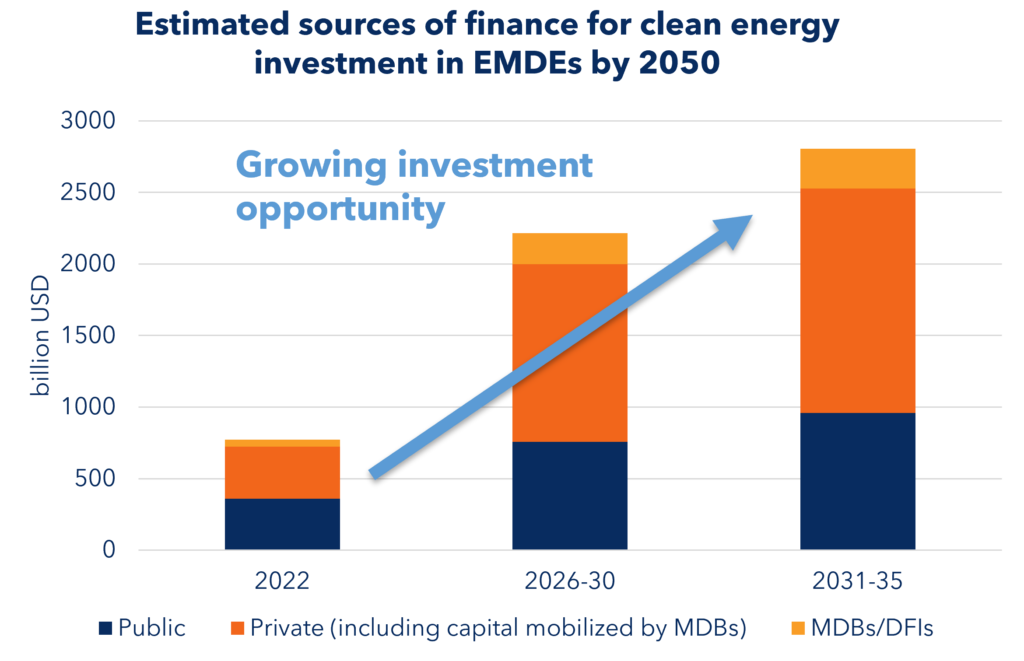
Chart showing estimated public, private and MDB/DFI financing for clean energy investment in emerging markets and developing economies through 2035

Delivering Robust, Project-Specific & Contractually Binding Impact Data

The ESG, Climate, and Impact commitments of the projects that ILX invests in are embedded in the contractual arrangements with the arranger MDB or DFI. This allows for greater leverage from lenders to deliver on specific impact goals, improve on ESG practices, and transparently measure and report impact.

Sustainability Stories

Arboreal

Matías Abergo, President and Co-founder of Arboreal

"This investment marks a major milestone for Arboreal. It will allow us to expand our industrial capacity in Uruguay, develop higher value-added wood solutions, and strengthen our ability to meet growing demand for more sustainable materials and construction systems in Uruguay, our region, and globally. We greatly value IFC’s trust and support as we continue building an industrial platform based on innovation, quality jobs, and the responsible use of renewable resources."
Khan Bank - Sustainability Story

Khan Bank, Mongolia

"The availability of long-term funding is critical to meeting the growing financing needs of Mongolia's MSMEs, agricultural sector, and green and sustainable finance initiatives. Through its investments in Khan Bank's syndicated financing facilities over the years, ILX Fund has enabled us to significantly expand our MSME, women-focused and sustainable lending activities in recent years, extending financing to entrepreneurs, SMEs, agricultural businesses and green projects across Mongolia while reinforcing our role as a leading sustainable finance provider in the country."
Aligned with
IIGCC logo
Net Zero Asset Managers Initiative logo
Joint Impact Model logo
Principles for Responsible Investment logo
nab impact investing logo
Task Force on Climate-Related Financial Disclosures logo
International Finance Corporation logo
Finance for Biodiversity Pledge logo
Global Impact Investing Network logo
GSG Impact logo
RepRisk ESG Business Intelligence logo
Investors for Purpose logo
norsif logo
X

Sustainability Report

Want to know more about ILX’s activities? Find the Sustainability Report 2024 here.

Sustainability Report