COP17 Yerevan: From biodiversity commitments to investable solutions at scale
Publication date: 4 November 2026
The message from COP17 in Yerevan was increasingly clear: nature is no longer only an environmental issue. It is an economic, financial and investment issue.
The Kunming-Montreal Global Biodiversity Framework (KMGBF), adopted in 2022, established 23 targets for 2030. Several are particularly relevant to the investment community:
Target 14, which calls for integrating biodiversity into policies, planning and development processes, and aligning financial flows with the goals of the Framework;
Target 15, which calls on businesses and financial institutions to assess, disclose and reduce their biodiversity-related risks, dependencies and impacts;
Target 19, which seeks to mobilise at least US$200 billion per year for biodiversity.
The economic case for action exists. An estimated 55% of global GDP, around US$58 trillion, is moderately or highly dependent on nature. In Asia and the Pacific, this dependence has been estimated higher, at around 75% of GDP. Agriculture, fisheries, forestry, and tourism are among the sectors most visibly dependent on natural capital, but nature also affects other key sectors such as food and water security, employment, productivity and economic resilience.(World Wildlife Fund, 2025)
Despite this, nature continues to be degraded and remains structurally underfunded. For pension funds and other institutional investors with long investment horizons, this matters. Nature loss is a long-term financial risk, affecting companies, supply chains, and ultimately the economies on which future pension payments depend.
For institutional investors, the biodiversity agenda therefore means (1) investing more in activities that benefit nature, while (2) ensuring that investment decisions and economic activities do not cause significant harm.
These two dimensions are increasingly visible in the work of Multilateral Development Banks (MDBs), which support the implementation of the KMGBF by channelling international public finance towards nature-related solutions, mobilising private capital, and strengthening the frameworks through which nature-related investments are identified, assessed and tracked.
At ILX, both dimensions are also relevant across targets 19, 14, and 15:
Target 19: finding nature finance within scalable emerging-market portfolios
ILX’s experience shows that nature finance does not need to be a separate, specialist allocation. It can be part of a diversified emerging-market portfolio, which meets pension fund requirements by providing scale and diversification.
Following publication of the MDB Common Nature Finance Taxonomy in 2025, ILX mapped its existing portfolio against the framework and found that approximately 9% already qualified as nature finance. The portfolio had not originally been constructed as a dedicated biodiversity strategy. This shows that nature-related investments already exist within a broader emerging-markets portfolio, but there is a need to identify them and classify them consistently. For pension funds, the opportunity is therefore not limited to specialist allocations but can form part of a diversified portfolio that combines biodiversity ambitions with diversification and sizable ticket allocations.
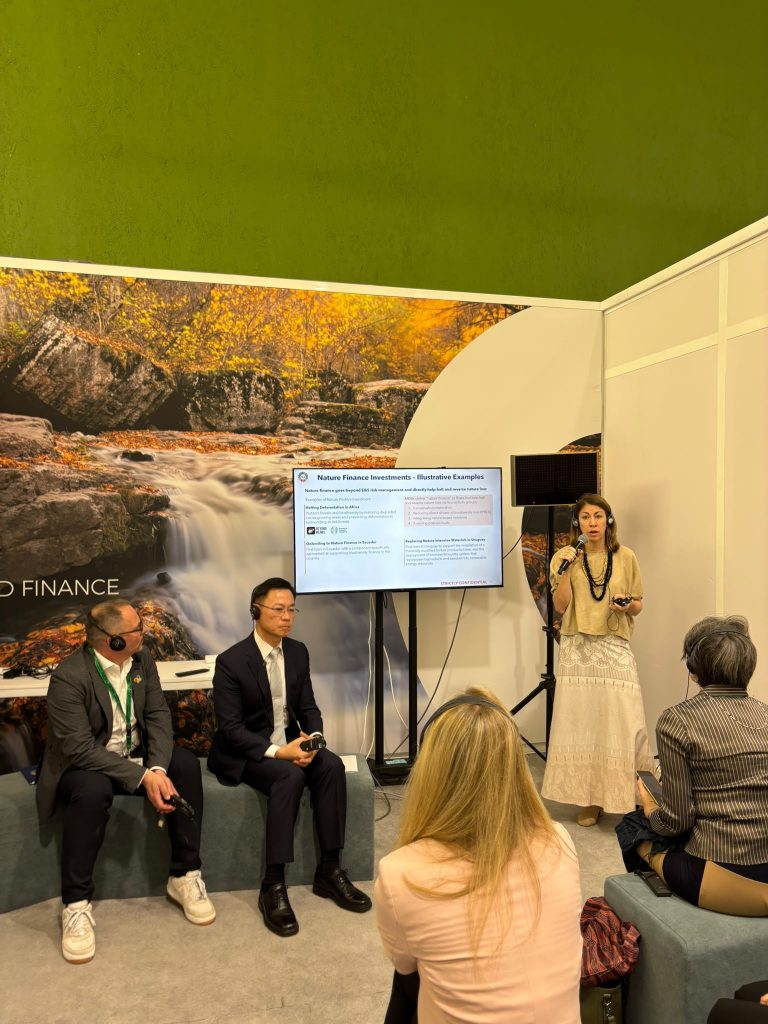
Examples from ILX’s portfolio illustrate what this looks like in practice:
- Biodiversity finance in Ecuador. ILX invested US$25 million alongside IFC in a US$100 million senior loan to Produbanco, with part of the financing (15%) specifically dedicated to biodiversity-related lending. Eligible activities are defined through use-of-proceeds criteria aligned with IFC’s Biodiversity Finance Reference Guide, covering biodiversity conservation and restoration, habitats, ecosystem services and sustainable natural-resource management.
- Halting deforestation in Africa. A US$45 million ILX investment forms part of a US$400 million sustainability-linked facility for an agricultural commodities business. The financing includes a zero-deforestation commitment covering high-risk supply chains including cocoa, coffee, soya, cashew and cotton, alongside landscape reforestation measures and monitoring of land conversion.
- Replacing nature-intensive materials in Uruguay. ILX has exposure to an FSC-certified mass-timber producer, where sustainably managed timber can provide an alternative to more carbon- and resource-intensive construction materials. The investment supports a thermally modified timber production line and a biomass system that repurposes production by-products and sawdust.
Targets 14 and 15: integrating biodiversity into investment decisions and preventing significant harm
Financing activities that contribute positively to nature is only one part of the work needed. Equally important is ensuring that investment and economic activity systematically account for biodiversity risks and impacts.
GBF Target 14 calls for biodiversity and nature finance to be integrated into policies, regulation, planning, and development processes, including the progressive alignment of public and private financial flows with the goals of the GBF. Target 15 complements this by encouraging businesses and financial institutions to assess, monitor, disclose and reduce their biodiversity-related risks, dependencies, and impacts.
Together, these targets aim to bring biodiversity more directly into financial and investment decisions, rather than treating it as a separate area in conservation investments.
This is where the environmental and social E&S standards and compliance operations developed by MDBs and Development Finance Institutions (DFIs) over decades become relevant. As highlighted in EBRD’s work on MDB operations and biodiversity objectives, these frameworks support global biodiversity goals by integrating biodiversity considerations into planning and assessment processes, pollution prevention, stakeholder engagement and consultation, ecosystem services management and disclosure approaches. These contributions extend across several GBF targets, including Targets 7, 11, 14, 15, 21 and 22.
Thus, MDB and DFI E&S frameworks provide an already established architecture for translating biodiversity objectives throughout the project lifecycle. Biodiversity safeguards such as IFC Performance Standard 6 require biodiversity due diligence, mitigation strategies and ongoing monitoring, with the objective of no net loss in natural habitats and net gain in critical habitats. The Do No Significant Harm (DNSH) approach is particularly relevant in this context. While not a standalone GBF target, it offers a practical way of operationalising aspects of Targets 14 and 15: ensuring that investments contributing to one sustainability objective do not simultaneously create significant negative impacts on biodiversity or other environmental objectives.
ILX’s investments provide tangible examples of what this can mean at asset level:
- Wind farms in Georgia and Azerbaijan: biodiversity assessments focus on impacts on local flora and fauna and, particularly, bird and bat collision risks. Biodiversity Action Plans include monitoring, mitigation, and turbine switch-off mechanisms. Technologies such as IdentiFlight cameras can detect approaching birds and temporarily stop turbines when collision risks become high.
- A desalination plant in the Middle East: the project relocated marine works to an industrial shoreline away from a marine reserve to reduce risks to coral ecosystems and other sensitive habitats. Design measures included a lagoon-style intake with screening, a fish-return system and a bubble curtain.
- Lithium production in Argentina: biodiversity assessments covered water resources, bird species and local ecosystems, with habitat restoration measures, an Offset Management Plan and a commitment to biodiversity net gain.
These examples and the solutions applied to risks show that an activity can be positive for one sustainability objective while creating risks for another. A wind farm may contribute to climate mitigation, for example, but still create significant biodiversity impacts if it is poorly located or managed. Institutional investors therefore need both take into account both sides of the equation:mobilising capital towards nature-positive outcomes and applying robust biodiversity safeguards across the wider portfolio.
Building the investment architecture for nature
COP17 was greatly focused on continuing to build the necessary architecture for nature. MDBs and other organisations are increasingly developing common definitions, metrics, and tools required to translate biodiversity ambitions into investment processes.
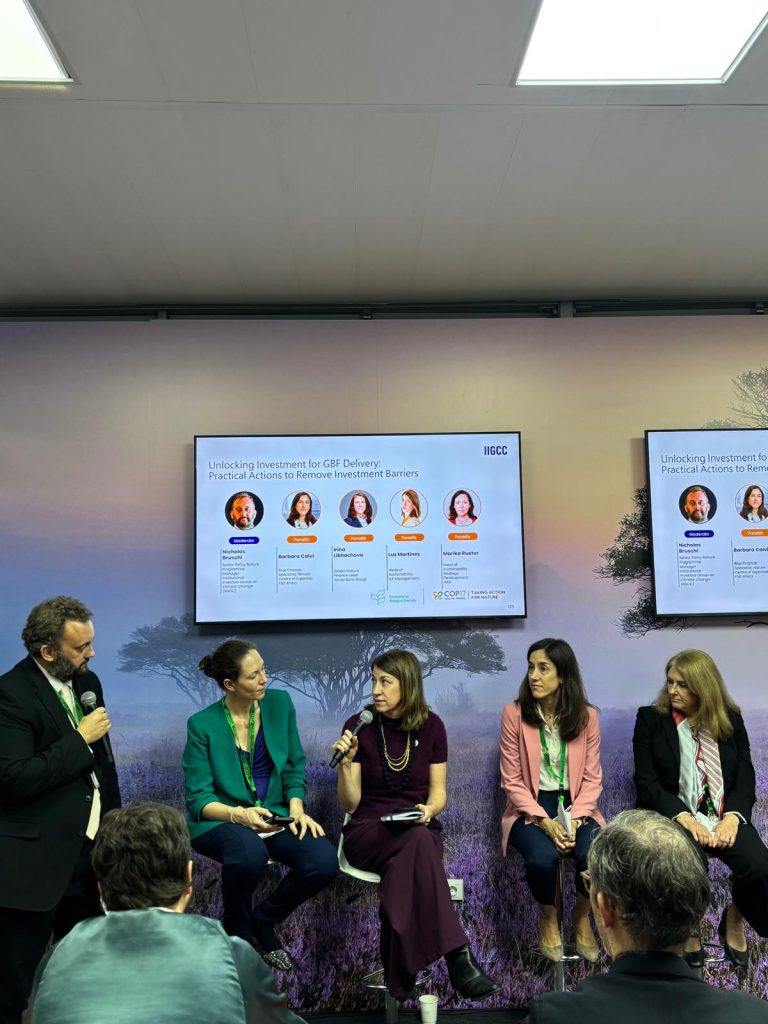
Notable publications included the MDB Nature Group’s Investing in Nature: Status on Operationalizing the Common Principles, Taxonomy, and Guide on Results Metrics, EBRD’s Identifying Opportunities to Support Biodiversity Objectives Through MDB Operations, the OECD’s An Overview of Global Biodiversity Finance, and IIGCC’s Nature Investment Toolkit.
The significance for institutional investors is important: common taxonomies, credible safeguards, and comparable metrics can help nature finance move from ambition towards an investable asset class. Similarly, established environmental and social risk assessment processes can help embed biodiversity considerations directly into investment decisions.
ILX at the intersection of MDBs and asset owners
ILX sits at the intersection of two types of institutions that are critical to closing the nature-finance gap: MDBs that originate, structure and monitor investments across emerging markets, and institutional investors managing the long-term savings of millions of pension beneficiaries.
In Yerevan, ILX therefore engaged with both MDBs and institutional investors on how private institutional capital can contribute to nature objectives, particularly across emerging markets and developing economies, where many of the world’s most important ecosystems and biodiversity hotspots are located and where investment needs are considerable and growing.
The discussion is no longer simply about whether investors should consider nature. The challenge now is to build credible, investable, and scalable pathways that connect biodiversity objectives with institutional requirements for risk, return, diversification and portfolio construction.
For ILX, the takeaway from Yerevan is clear: nature needs both sides of the capital equation: scaling investment that helps halt and reverse biodiversity loss, while ensuring that mainstream investment does not undermine these objectives. MDBs and institutional investors have an important role to play in delivering both.
Luz Martinez, Head of Sustainability, and Merita Salihu, Sustainability Officer, attended COP 17 in Yerevan, Armenia.